Could vibe coding save your life?
F12 applied agentic AI to ship a life-saving app and cut delivery costs by 40% in the process.
You’re stuck halfway up a mountain with a broken leg. It’s the middle of nowhere, and the hypothermia is setting in. Actually, it’s a stroke… or is it an allergic reaction? No, you’ve been struck by lightning.
Oh, wait. You’re trapped in a cave.
Anything can happen to the people exploring the UK’s most awe-inspiring and unforgiving terrain. Luckily, we have experts for this sort of thing. And when you’re found by Mountain Rescue England and Wales (MREW), the proper treatment can be a matter of life and death.
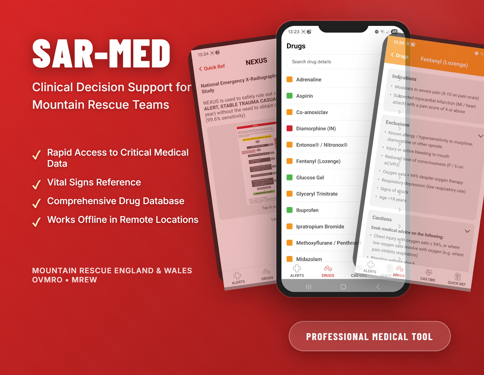
That’s where SAR-MED steps up.
What is SAR-MED, and why does it matter?
All MREW Casualty Care Certificate (CCC) holders receive a waterproof pocketbook that outlines what to look for, which drugs to use, and how to administer them. It’s essential, but it’s also static.
The SAR-MED App was launched to keep guidance up to date as protocols change. Then the SAR-MED Clinical Field app was created: a comprehensive, rapid-access field guide for managing trauma and medical incidents in remote environments.
No pressure, then.
Our mission: take a trusted iOS app and ship it on Android too
SAR-MED began life as an iOS app. Our job at F12 was to deliver a React Native version that worked seamlessly across both iOS and Android, alongside robust testing and ongoing maintenance.
Everything had to look and feel the same. i.e., boringly predictable, reliable, and easy to use. No clever flourishes. No novelty UI. Just muscle memory and trust.
And it all had to work entirely offline.
Now for the twist.
We built it vibe-coded, with Codex driving
Say hello to the newest member of our team.
OpenAI Codex is an AI-powered software engineering agent that translates natural-language instructions into working code. It can operate inside your repo, make changes across files, and propose pull requests for review.
It never makes a brew, but it certainly pulls its weight.
We told Codex what we wanted:
-
Features
-
Fixes
-
Refactors
-
The messy glue that turns an idea into a shippable app
Out popped the code. Hey presto, we’re vibe-coders now.
But was it any good? How much could we actually trust it?
What “Codex as a teammate” actually looked like
Codex typed, wired, and implemented. Meanwhile, we carbon-based lifeforms owned the intent, architecture, quality, and release discipline.
We got on rather well.
Instead of copy-paste, we delegated for the win, handing Codex tickets like:
-
“Recreate this iOS screen layout and navigation flow”
-
“Implement offline persistence for acknowledgement state”
-
“Build the content renderer to support our custom markup rules”
-
“Track down why behaviour differs between dev and production builds”
-
“Refactor this messy component into a reusable pattern without changing behaviour”
It changed the pace entirely.
Our vibe coding verdict: The key takeaways
It’s early days, admittedly. But we have big hopes for agentic AI—even if it never takes us out of the loop.
Here’s our honest assessment to date:
The Good
-
Agent-level output. Codex worked across multiple files and patterns. It felt like a collaborator, not autocomplete.
-
Glue work disappeared. Data wiring, state plumbing, persistence, and edge-state handling (the tedious but necessary stuff) were handled quickly.
-
Better focus for humans. Engineers spent more time on correctness, UX, and safety, not boilerplate.
-
Fast UI polish. Vague feedback turned into precise diffs. Codex is particularly strong at “make this feel native”.
-
Stronger debugging. Codex investigated before changing code: hypotheses → verification → most minor fix.
The Bad
-
Confidently wrong sometimes. Invented APIs. Over-ambitious refactors. Everything still needs review.
-
Edge cases surface faster. Offline, device-specific, OS-specific bugs still require humans. AI helps after you have a repro.
-
Release pain remains. App Store submissions, screenshots, admin… still very much a human job.
AI doesn’t remove work, it moves it
We wrote less code by hand. We spent more time guiding and checking it:
-
Defining constraints
-
Designing for offline-first predictability
-
Setting guardrails for agent work
-
Reviewing diffs like we actually cared
-
Testing on real devices
Which, for a medical app, is exactly where you want the effort.
Our Top Five prompt hacks for Codex
What made Codex genuinely helpful was treating prompts like proper tickets:
-
Goal: what the user should experience
-
Constraints: what must not change
-
Acceptance criteria: what “done” means
-
Edge cases: offline, empty state, first-run, resume
-
Verification: how we’ll confirm it works
The one line that saved us repeatedly
“Make the smallest change that fixes this.”
AI loves refactoring. Shipping apps loves stability.
The value we delivered for our customer
SAR-MED is now available on both iOS and Android, used in real rescues, and helping the next generation of rescuers pass their training exams.
It was delivered with:
-
Faster turnaround
-
Lower cost (around 40% saved)
-
No compromise on safety or quality
The formula was simple:
-
AI agents for speed
-
Humans for intent, judgment, and accountability
-
A tight loop of review, verification, and iteration
Don’t just take our word for it
It’s one thing for us to say the tech works. It’s another to see it validated by the people actually out there saving lives.
The project is currently featured in the Winter 2026 edition of Mountain Rescue Magazine.
Pages 12–14: SAR-MED App launched to support Casualty Care across MREW The feature details the full journey—from the original waterproof pocketbook to the digital, agentic-built solution now in the hands of rescuers. It’s a great look at how the app is being used on the ground (and up the cliffs).
You can read the full spread in the digital edition here: Mountain Rescue Magazine: Winter 2026
Want to vibe code like a pro?
Agentic AI can absolutely accelerate delivery. But only with guardrails, good ticketing, and engineers who know where the sharp edges are.
At F12 Consult, we help teams adopt AI-assisted development that actually ships:
-
Agent-ready delivery workflows
-
Guardrails and governance
-
Code review and hardening
-
Calm, controlled cross-platform execution
Vibe code. Stone cold sober. Zero surprises.
If you have an iOS-only app, a legacy codebase, or a product that needs to go cross-platform without doubling your team, get in touch.
Lost in the wilderness?
You may bump into our Chairman, Howard Barton, and Molly, his fully trained mountain search-and-rescue dog.
Don't hesitate,
get in touch today
We’d love to get to know you and your business better.